❋
Lighting 101
What to ExpectThere’s a lot that goes into a thoughtful lighting plan. The details can make all the difference.
❋ Types of lighting❋ Electrical Symbols for lighting plans❋ Lighting Fixtures❋ Defining a lamp (aka bulbs)❋ Lighting placement best practice❋ ADA Regulations❋ Ceiling Fans❋ Interior & Exterior Ratings❋ Building Code
Types of Lighting
Ambient: General, consistent, and uniform lighting
Task Lighting: Intense, direct lighting focused for reading, cooking, sewing, etc. This lighting should be glare-free
Accent Lighting: Aesthetic lighting that creates a mood or highlights a room feature
Types of Lighting Fixtures
Flush Mounts
Semi-Flush Mounts
Chandeliers
Sconces or Brackets
Pendants
Lanterns
Recessed
Under-cabinet
Step Lights
Vanity
Track Lighting
Floor & Table Lamps
Swing Arm Lamps
Picture Lights
Exterior Pier Mounts
Exterior Post Mounts
Landscape Lighting
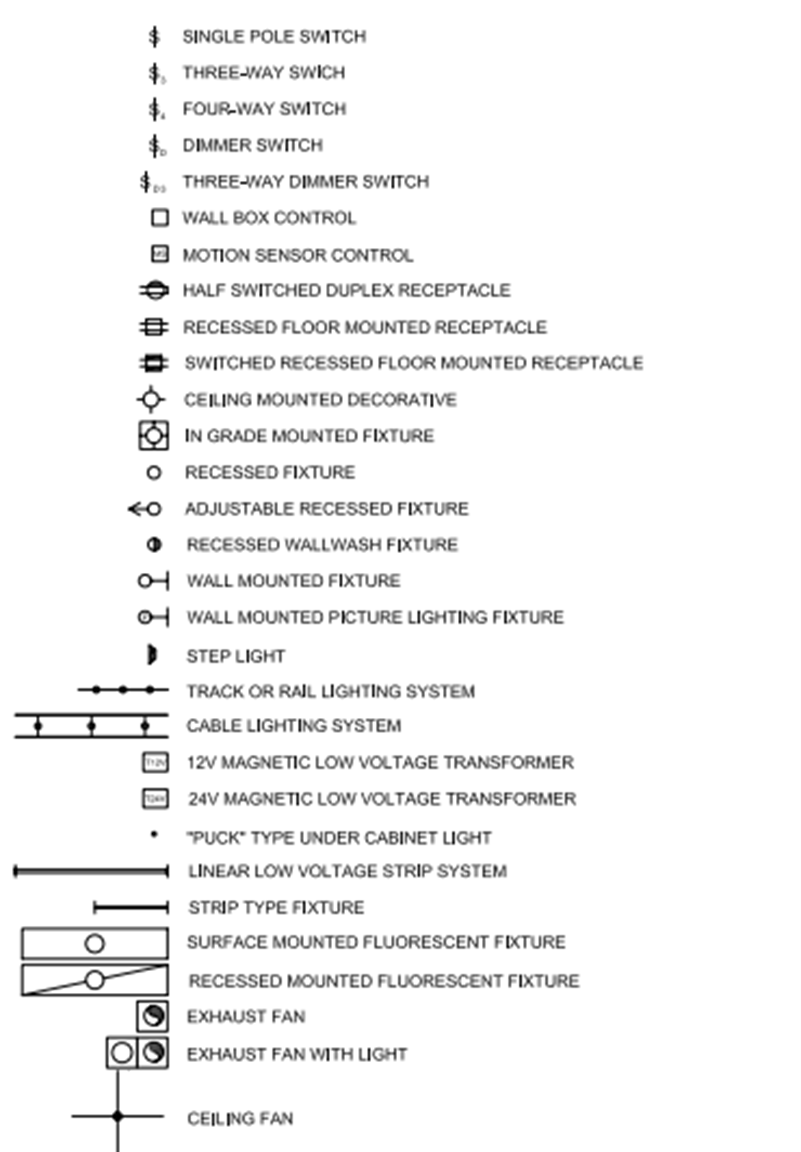
Electrical Symbols for Lighting Plans
Defining a Lamp
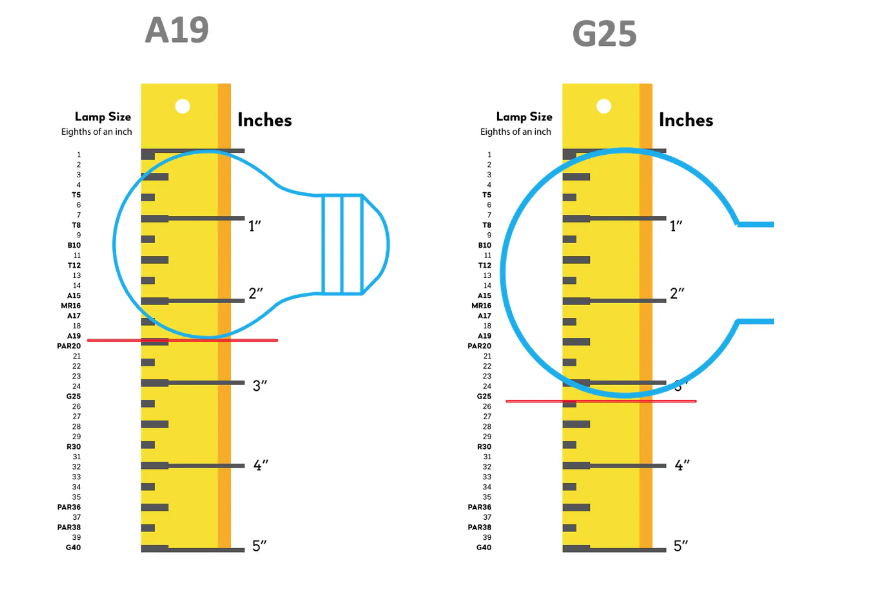
Getting the correct lamp in a fixture can make all the difference. Your lamp preference can even influence your fixture choice.
Shapes & Sizes
Bulb widths are measured by 1/8 of an inch. A standard A19 bulbs is nineteen1/8 of an inch or 2 3/8”

Type A

Type B

Type C

Type D
Lamp Terminology
-
The bulb finish can affect the look of a light fixture.
-
Lumens measure the amount of light.
-
Not all bulbs are dimmable, and not all bulbs dim the full range. Also, not having a compatible bulb and dimmer can cause buzzing and flickering.
-
The amount of power consumed by a bulb. All fixtures are rated for a maximum wattage.
-
This is a standard that helps identify warm and cool light. This is measured in Kelvins. The higher the Kelvin the cooler the light. The lower the Kelvin the warmer the light. A sunny day may be 5000K and candlelight is closer to 2000K. Most interiors are 2700K or 3000K.
Some bulbs have a Color Rendering Index (CRI) rating. This is a measurement of the lights color accuracy. It is measured from 0 to 100. The higher the CRI the more accurate the color and the more clean & crisp the color will appear.
Lighting Placement
Above a table
Chandeliers should hang 30 to 36” above a table on an average ceiling eight. Allow a minimum of 6” from the edge of the chandelier to the edge of the table.
Taller ceilings may use larger chandeliers hung higher above the table
Centered in a room
Add the length and width of the room to get the approximate chandelier diameter. Allow a minimum of 7’ clearance to walk below.
Recessed Track and Rail placement For Wall Washing
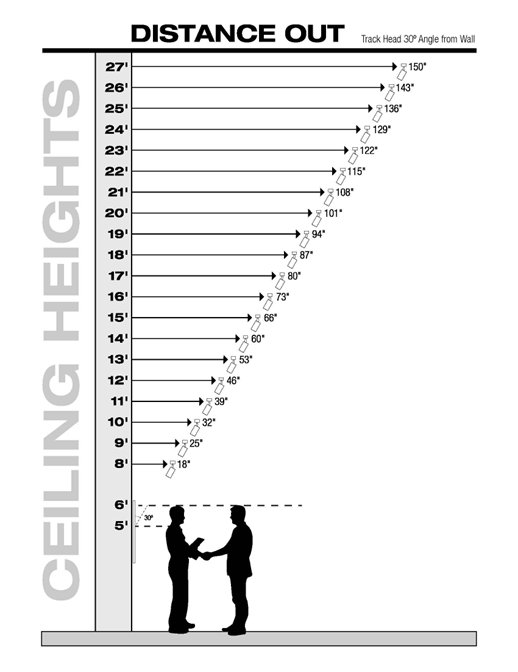
Use this tool to determine proper track light spacing and positioning based on a 30-degree angle from the wall. Fine-tune the layout to achieve consistent, balanced wall wash and optimal illumination.
Recessed Track and Rail placement For Wall Washing
Use this tool to determine proper track light spacing and positioning based on a 30-degree angle from the wall. Fine-tune the layout to achieve consistent, balanced wall wash and optimal illumination.
Lighting Distance
ADA Regulations for Sconces
The American with Disabilities Act (ADA) limits wall-mounted luminaires to four inches in depth when located between 27 inches and 84 inches from the finished floor level of walks, halls, corridors, passageways, or aisles in public spaces. Many sconces meet this requirement at any mounting height. Sconces greater than four inches in depth can be used, but they must be mounted higher than 84 inches from the finished floor.
Code for over a bathtub
In Minnesota, no cord-connected luminaires, chain/cable-suspended luminaires, track lighting, or paddle fans with lights are allowed within a zone measured 3 feet horizontally and 8 feet vertically from the top of a bathtub rim or shower stall threshold. This 3'x8' zone includes the space directly over the tub or shower.
Codes for Closets
Many places have codes for lighting in closets. This is the local code in MN
Incandescent luminaires with open or partially enclosed lamps and pendant fixtures or lamp holders are not permitted in clothes closets.
045 NEC 410.16 Luminaires in clothes closets shall have the following minimum clearances from the defined storage space:
§ 12 inches for totally enclosed surface-mounted incandescent or LED luminaires on the ceiling or above the door
§ 6 inches for totally enclosed recessed incandescent or LED luminaires on the ceiling or above the door
§ 6 inches for surface-mounted or recessed fluorescent luminaires on the ceiling or above the door 046 NEC 410.2 Defined closet storage space extends from the floor to a height of 6-feet or the highest clothes-hanging rod and 24-inches from the sides and back of the closet walls, and continuing vertically to the ceiling parallel to the walls at 12- inches or the shelf width, whichever is greater.
047 NEC 410.16 Incandescent luminaires with open or partially enclosed lamps and pendant fixtures or lampholders are not permitted in clothes closets
Ratings for Interior and Exterior Lighting

Ceiling Fans
Fans have either AC or DC motors.
AC fans are usually less expensive to purchase.
DC fans use up to 70% less energy than an AC motor fan. They run cooler and quieter for longer life! They are usually more expensive to purchase.
How to choose a fan:
Where will it be installed?
Dry rated fans are for interior use.
Damp rated fans are for outdoor covered areas or high humidity indoor locations
Wet rated fans are for outdoor locations with direct contact with water.
Size
This is determined by the size of the room, but it can also be a personal preference.
Small rooms usually use a 42” to 52” fan
Large rooms use 52” or larger fans
Great rooms may use 60” or larger fans. You might even use multiple fans in a very large or long room.
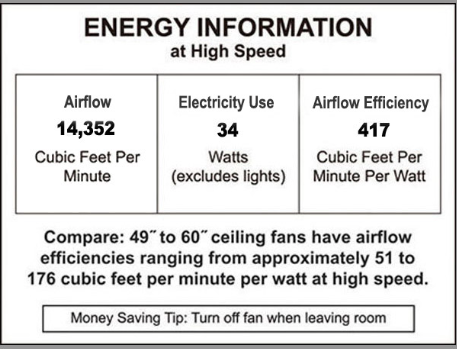
Airflow is the most important factor when buying a fan. The larger the airflow number the more air the fan will push at its highest speed
All fans have an Energy Information Label.